A few of the books in the shop are listed on my grandson’s site (“Aron Andy’s Corner”) on Bokbörsen, a Swedish internet marketplace:
Listed below are the main books that I have published as author or editor, not the books that are on sale at the shop. I don’t have too many copies to sell, but would be happy to loan you one if you’re interested.
If you scroll down the page, you can download a pdf version of the last one, The Making of Green Engineers, which, as far as I can tell, is not available for purchase on the internet. It is a kind of academic memoir that I published just before I retired in 2013. For the others, you can order copies by clicking on the links below the titles.
*********
The Steam-Powered Automobile: An Answer to Air Pollution (Indiana University Press, 1970). This was my first book, written in my junior year at college, about the attempts to develop alternatives to the internal combustion engine that powers automobiles. https://www.abebooks.com/Steam-Powered-Automobile-answer-air-pollution-Jamison/31888609327/bd
National Components of Scientific Knowledge: A Contribution to the Social Theory of Science (Research Policy Institute 1982). This was my doctoral thesis in theory of science that I defended at the University of Gothenburg in 1983. It is an attempt to trace the history of theorizing about the relations between science and society and compare those relations in Sweden and Denmark. https://www.abebooks.com/first-edition/National-Components-Scientific-Knowledge-Contribution-Social/22463101410/bd
The Making of the New Environmental Consciousness, co-author with Jacqueline Cramer, Ron Eyerman and Jeppe Læssœ (Edinburgh University Press, 1990). This was the result of a research project, comparing the development of environmental movements in Sweden, Denmark and the Netherlands.

Social Movements. A Cognitive Approach, co-author with Ron Eyerman (Polity and Penn State Press, 1991)
“This book offers a new approach to the study of social movements. Integrating American and European approaches, Eyerman and Jamison argue that social movements are forms of activity whereby participants create new kinds of social identities not only for themselves but for their societies. They emphasize the “cognitive praxis” – processes of collective learning – that take place in social movements and discuss the various types of movement intellectuals, giving special attention to the American civil rights movement and environmental movements. The result is a study which develops major theoretical innovations as well as integrating a wide range of empirical material.” (Publisher’s blurb)

Seeds of the Sixties, co-author with Ron Eyerman (University of California Press, 1994)
“In this deft and accessible slice of intellectual history, the authors, American scholars at Lund University in Sweden, profile 15 people who helped transform public discourse in the 1950s, carving out “breathing space” for the ferment to follow. Their choices, in five categories, are solidly representative: critics of mass society C. Wright Mills and Erich Fromm; early environmentalists Lewis Mumford and Rachel Carson; intellectual innovators Herbert Marcuse and Margaret Mead; cultural pioneers Allen Ginsberg and James Baldwin; political agitators Saul Alinsky and Martin Luther King. The authors combine biography with analysis for each of their profiles, and conclude thoughtfully by suggesting the different ways in which the ideas and actions of their subjects influenced the days–and the decade–ahead.” (Review in Publishers’ Weekly)
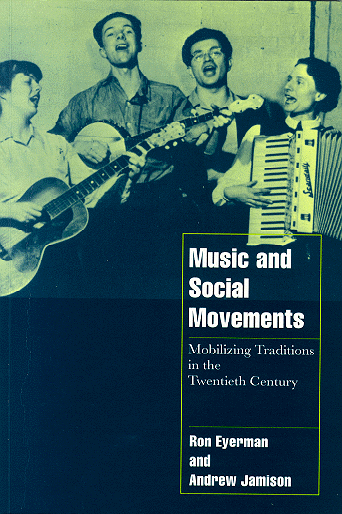
Music and Social Movements, co-author with Ron Eyerman (Cambridge University Press, 1998)
https://www.cambridge.org/core/books/music-and-social-movements/16F59C7E95CA84679C49D320EF2B6460
“Music and song are central to modern culture–social movements to cultural change. Building on their studies of the sixties culture and the theory of cognitive praxis, the authors examine the mobilization of cultural traditions and the formation of new collective identities through the music of activism. Specific chapters examine American folk and country music, black music, music of the sixties, and the transfer of the American experience to Europe. This highly readable book is among the first to link social movement and cultural theory.” (Publisher’s blurb)
The Intellectual Appropriation of Technology, edited with Mikael Hård (MIT Press, 1998)

The Making of Green Knowledge. Environmental Politics and Cultural Transformation (Cambridge University Press, 2001)
“The Making of Green Knowledge provides a wide ranging introduction to the politics of the environment and the development of environmental knowledge. Focusing in particular on the quest in recent years for more sustainable forms of socio-economic development, it attempts to place environmental politics within a broad historical perspective, and examines the different political strategies and cultural practices that have emerged. The Making of Green Knowledge is a uniquely personal exploration of the relationship between sustainable development, public participation, and cultural transformation. Through a highly accessible mix of theory, practical analysis and personal reflection it seeks to bring the making of green knowledge to life.” (Publisher’s blurb)

Hubris and Hybrids. A Cultural History of Technology and Science, co-author with Mikael Hård (Routledge, 2005)
“Human societies have not always taken on new technology in appropriate ways. Innovations are double-edged swords that transform relationships among people, as well as between human societies and the natural world. Only through successful cultural appropriation can we manage to control the hubris that is fundamental to the innovative, enterprising human spirit; and only by becoming hybrids, combining the human and the technological, will we be able to make effective use of our scientific and technological achievements. This broad cultural history of technology and science provides a range of stories and reflections about the past, discussing areas such as film, industrial design, and alternative environmental technologies, and including not only European and North American, but also Asian examples, to help resolve the contradictions of contemporary high-tech civilization.” (Publisher’s blurb).
A Hybrid Imagination: Science and Technology in Cultural Perspective, co-author with Steen Hyldgaard Christensen and Lars Botin (Morgan & Claypool, 2011).
The Making of Green Engineers. Sustainable Development and the Hybrid Imagination (Morgan & Claypool 2013)

“This book discusses the ways in which engineering educators are responding to the challenges that confront their profession. On the one hand, there is an overarching sustainability challenge: the need for engineers to relate to the problems brought to light in the debates about environmental protection, resource depletion, and climate change. There are also a range of societal challenges that are due to the permeation of science and technology into ever more areas of our societies and everyday lives, and finally, there are the intrinsic scientific and technological challenges stemming from the emergence of new fields of “technosciences” that mix science and technology in new combinations.In the book, the author discusses and exemplifies three contending response strategies on the part of engineers and engineering educators: a commercial strategy that links scientists and engineers into networks or systems of innovation; an academic strategy that reasserts the traditional values of science and engineering; and an integrative strategy that aims to combine scientific knowledge and engineering skills with cultural understanding and social responsibility by fostering what the author terms a “hybrid imagination.” Professor Jamison combines scholarly analysis with personal reflections drawing on over forty years of experience as a humanist teaching science and engineering students about the broader social, political and cultural contexts of their fields.” (Publisher’s blurb)
Professor Jamison combines scholarly analysis with personal reflections drawing on over forty years of experience as a humanist teaching science and engineering students about the broader social, political and cultural contexts of their fields.
 AndrewJamison